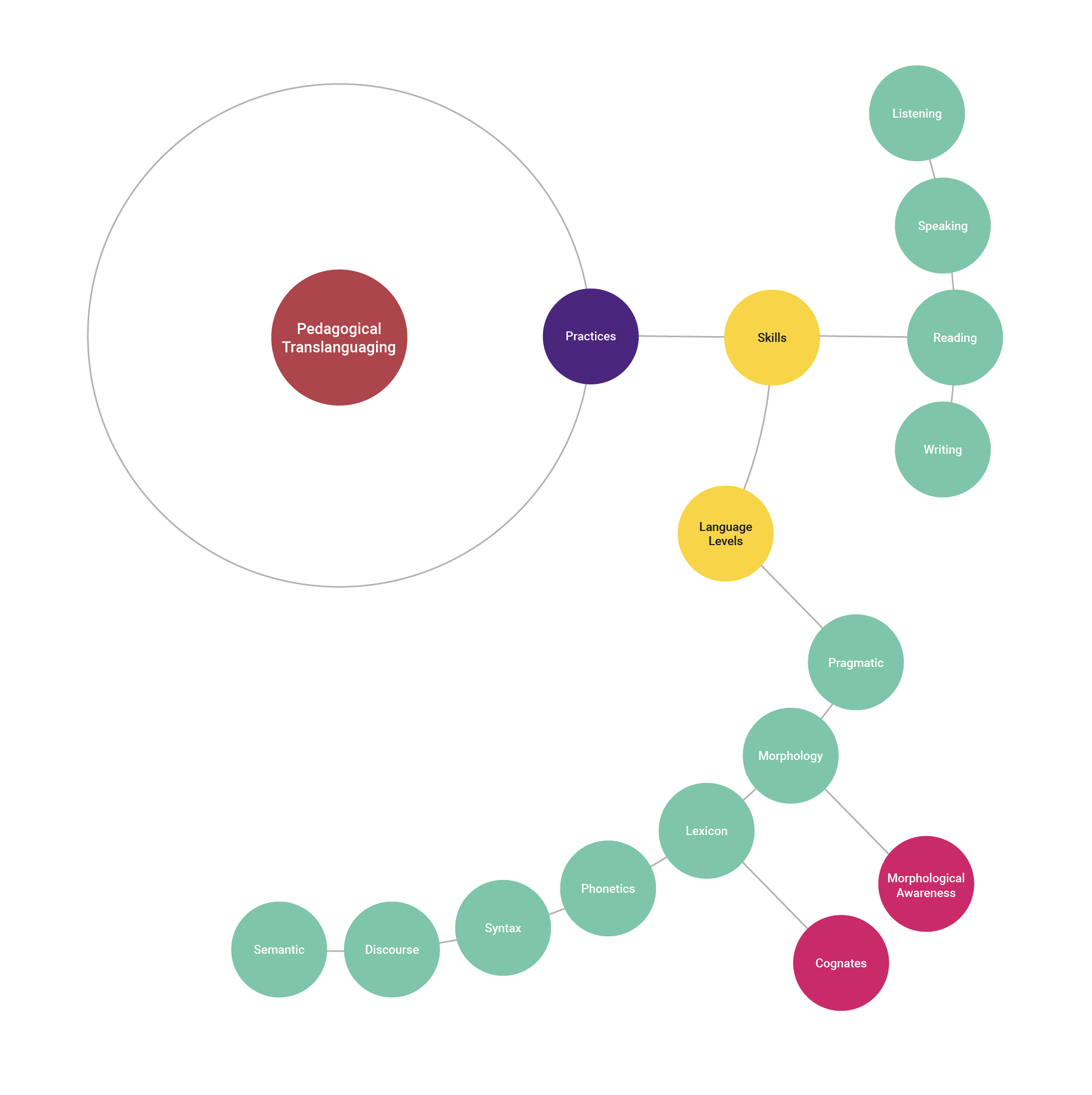
Pedagogical translanguaging is a methodology that includes the alternation of languages during the lessons. We use it in educational contexts and the teachers always plan the activities.
El pedagogical translanguaging es una metodología que permite el uso de varios idiomas dentro de las clases. Se usa en el contexto educativo y se caracteriza porque los profesores han de planear previamente las actividades y los usos de los idiomas.
(Cenoz & Gorter, 2021)
“Pedagogical translanguaging embraces different pedagogical practices, but they all use resources from the students’ whole linguistic repertoire and are planned by the teacher with a pedagogical purpose” (Cenoz & Gorter, 2021, p.30).
El pedagogical translanguaging usa diferentes prácticas pedagógicas, pero todas ellas usan los recursos lingüísticos de los estudiantes y son planeadas por los profesores con un propósito pedagógico.
The competency in a language is based on the competency in the basic language skills. The basic skills are Listening, Speaking, Reading and Writing (LSRW).
La competencia en un idioma se basa en el grado de destreza adquirido en las diferentes habilidades básicas del lenguaje. Estas habilidades son: comprensión oral, expresión oral, comprensión escrita y expresión escrita.
(Lakhera & Biswal, 2017).
“Pedagogical translanguaging in language classes can focus on different levels: phonetics, lexicon, morphology, syntax, pragmatics and discourse” (Cenoz & Gorter, 2022, p.347).
El pedagogical translanguaging dentro de las clases de idiomas se puede enfocar en diferentes niveles: fonética, léxico, morfología, sintaxis, pragmática y discurso.
Listening is one of the most important language skills. For effective communication, listening effectively is a prerequisite. Listening is to draw out meaning from the messages by the speaker.
Activities:
La comprensión oral es una de las habilidades más importantes. Para comunicarse es necesario entender lo que nos dicen. La comprensión oral extrae el significado de los mensajes que crea el hablante.
Actividades:
(Cenoz & Gorter, 2021; Lakhera & Biswal, 2017).
Speaking skill is used by students throughout their academic life. Speaking skill is important for better communication.
Activities:
La expresión oral es una habilidad que usan los alumnos durante toda su vida académica. La expresión oral es importante para una buena comunicación.
Actividades:
(Cenoz & Gorter, 2021; Lakhera & Biswal, 2017).
Reading is more than just decoding the written text. It is a process wherein the reader reads a text as input and comprehends and analyses the written text.
Activities:
La comprensión escrita es más que descifrar un texto escrito. Es un proceso en el que el lector lee un texto y entiende y analiza lo que está escrito.
Actividades:
(Cenoz & Gorter, 2021; Lakhera & Biswal, 2017).
“Writing as a communication tool is a mean of conveying one’s thought in the written form. The writing process involves certain linguistic skills” (Lakhera & Biswal, 2017, p. 36).
Activities:
La expresión escrita es una herramienta en la que se plasman de manera escrita los pensamientos. Escribir implica diferentes habilidades lingüísticas.
Actividades:
(Cenoz & Gorter, 2021; Lakhera & Biswal, 2017).
“The study of how context affects meaning – for example, how the sentence It’s cold in here comes to be interpreted as “close the windows” in certain situations – is called pragmatics” (Fromkin, Rodman & Hyams, 2011, p.140).
El estudio sobre cómo el contexto afecta al significado es lo que llamamos pragmática.
“The study of the internal structure of words, and of the rules by which words are formed, is morphology” (Fromkin, Rodman & Hyams, 2011, p.41).
El estudio de las estructuras internas de las palabras y las reglas por las que se forman las palabras se llama morfología.
“The mental storehouse of information about words and morphemes is what we have been calling the lexicon” (Fromkin, Rodman & Hyams, 2011, p.153).
Activities:
El almacenamiento de la información sobre palabras y morfemas es lo que se llama léxico.
Actividades:
(Busse, Cenoz, Dalmann, Rogge, 2020; Fromkin, Rodman & Hyams, 2011).
“When you know a language you know the sounds of that language, and you know how to combine those sounds into words” (Fromkin, Rodman & Hyams, 2011, p.189).
“The study of speech sounds is called phonetics” (Fromkin, Rodman & Hyams, 2011, p.190).
Activities:
Cuando se habla un idioma, se conoce el sonido de ese idioma y se sabe cómo formar esos sonidos en palabras. El estudio de los sonidos es lo que se llama fonética.
Actividades:
(Busse, Cenoz, Dalmann, Rogge, 2020; Fromkin, Rodman & Hyams, 2011)
“The part of grammar that represents a speaker’s knowledge of sentences and their structures is called syntax” (Fromkin, Rodman & Hyams, 2011, p.78).
Activities:
La parte de la gramática que representa el conocimiento de los hablantes en oraciones y sus estructuras es lo que llamamos sintaxis.
Actividades:
(Fromkin, Rodman & Hyams, 2011; Leonet, Cenoz & Gorter, 2020)
“Discourse analysis is concerned with the broad speech units comprising multiple sentences. It involves questions of style, appropriateness, cohesiveness, rhetorical force, topic/subtopic structure, differences between written and spoken discourse, as well as grammatical properties” (Fromkin, Rodman & Hyams, 2011, p.167).
Activities:
El discurso tiene que ver con el análisis del estilo, cohesión, adecuación, etc. de los textos o de los discursos orales.
Actividades:
(Leonet, Cenoz & Gorter, 2020; Fromkin, Rodman & Hyams, 2011)
“The study of the linguistic meaning of morphemes, words, phrases and sentences is called semantics.” (Fromkin, Rodman & Hyams, 2011, p.140).
El estudio del significado lingüístico de los morfemas, palabras y oraciones es lo que se llama semántica.
“Morphological awareness includes the ability to reflect about inflection, derivation and compounding” (Leonet, Cenoz & Gorter, 2020, p. 42).
Activities:
La conciencia morfológica incluye la habilidad de pensar sobre la flexión, derivación y composición de las palabras.
Actividades:
(Leonet, Cenoz & Gorter, 2020)
A cognate “is a word that shares similar orthographic and semantic characteristics in two languages” (Proctor & Mo, 2009, p. 126).
Activities:
Un cognado es una palabra que comparte una ortografía similar en dos o más idiomas y características semánticas.
Actividades:
(Proctor & Mo, 2009; Leonet, Cenoz & Gorter, 2020)
© 2026 DOMA